LinkedIn Learning
- 4.8
- Rating
- 10.00M
- Installs
- Free
- Price

 Analysis by App-foxy
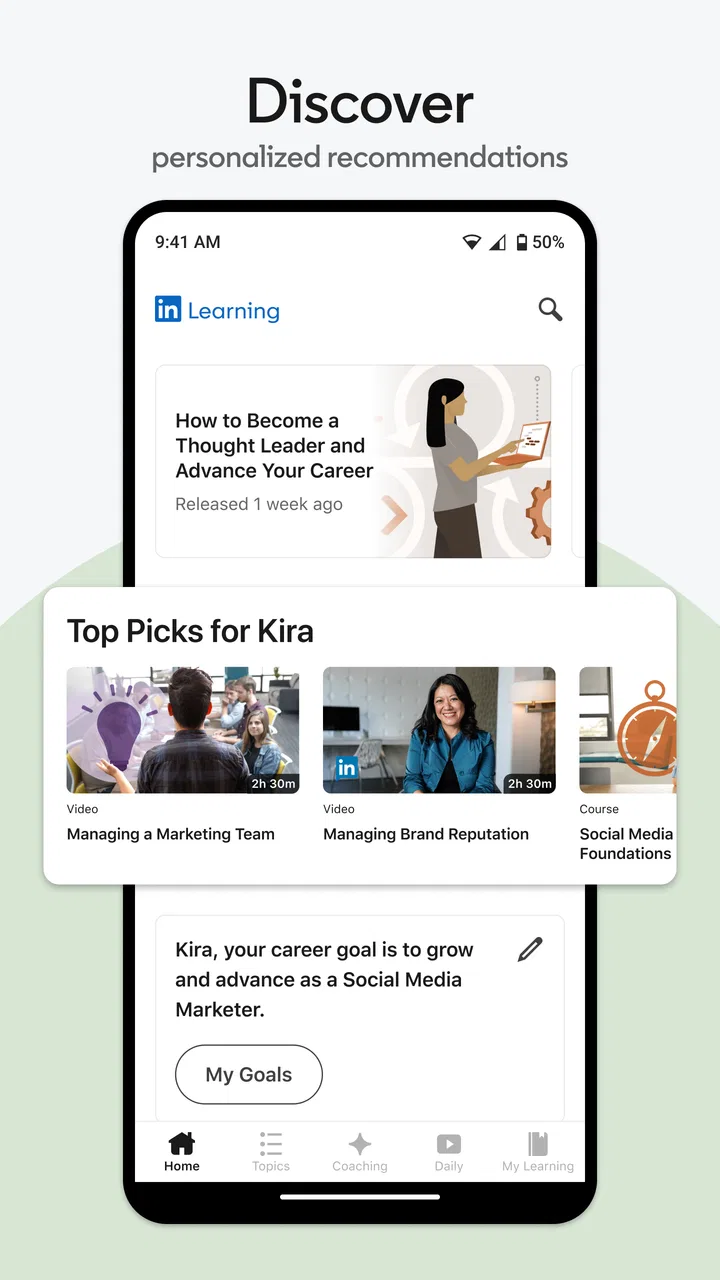
I came away from LinkedIn Learning feeling that it is less like a casual video app and more like a structured study shelf for people who want to improve a work-related skill without committing to a classroom. It belongs to the education category, comes from LinkedIn, and focuses on business, technology, and creative subjects. I found it most useful when I opened it with a specific goal in mind rather than browsing without a plan.
The app is free to install and suitable for Everyone, but that does not mean every learning option is free. In-app purchases are listed from $29.99 to $239.99 per item, so anyone considering serious long-term use should check the current access terms before building a study routine around a particular course. That distinction is important: the download is free, while access to learning content can involve a purchase.
Its public reception is strong, with a 4.8 average from around 179,000 ratings, and the app has passed 10 million installs. Those figures suggest that it has found a broad audience, but they do not remove the need to test whether its teaching style suits you. I would recommend it to someone who prefers guided lessons and professional topics; I would be more cautious for a learner seeking an entirely free, highly interactive classroom.
You May Also Like

 Blood Strike: 2.5 Anniversary
Blood Strike’s Loadouts Turn Every Drop Into a Tactical Gamble
A close look at Blood Strike’s custom loadouts: how fast access to signature weapons reshapes its battle royale rhythm, rewards preparation, and narrows the gap between fights.

 Pandora - Music & Podcasts
Pandora’s Music Is Easy to Start, but Harder to Recover
Pandora’s strength is its low-effort path from a seed to a station. Its weak spot is how much confidence it asks you to place in connection, setup, and quiet recovery.

 8 Ball Pool
 Is Built on Rivalries, Rematches, and Routine
A close look at the rivalries, rematches, shared routines, and unanswered safety questions that turn a quick pool match into a persistent mobile community.

 Samsung Music
’s Quiet Strength Is Playing What You Already Own
Its reach comes less from spectacle than from dependable access to a personal library. That simplicity is both the app’s strongest retention engine and its ceiling.

 AccuWeather: Weather Radar
AccuWeather Review: A Quick, Clear Forecast for Everyday Decisions
For everyday plans, the best forecast is the one you can understand quickly. AccuWeather makes rain timing, radar, and local conditions easy to act on, with a few trade-offs.

 Hill Climb Racing
Why Hill Climb Racing Still Turns Crashes Into One More Run
A tiny car, a bumpy hill and one more upgrade: Hill Climb Racing keeps resurfacing because its simple chaos makes every near-miss feel personal.
More From Our News Desk
View All News


Where the first session can become confusing
The most common difficulty is not necessarily a technical failure. It is choosing what to learn. A large education app can make every subject look equally urgent, and that can turn a short study session into a long browsing session. I get better results by starting with one outcome, such as understanding a spreadsheet workflow, improving a presentation, or learning the basics of a creative tool.
That approach also helps with course selection. Instead of searching for a broad label like “marketing” or “design,” I look for a lesson that matches the task I expect to perform soon. A narrow objective gives me a reason to finish the lesson and makes it easier to judge whether the material was useful.
Another point of friction is expecting the app to behave like a complete school. It can organize learning material, but watching a lesson is not the same as practicing a skill. I would keep a separate note, document, or project open while studying. For software subjects, following along with the relevant tool is far more valuable than passively letting a video play.
The app can also feel less satisfying if you want instant answers to a very specific problem. A course is usually arranged around a broader topic, so a short question may require finding the right section rather than receiving a single direct solution. For quick troubleshooting, a focused search engine result or official product documentation may be faster. For building a connected understanding of a subject, the guided format is more useful.
What I check before starting
My first setup check is simple: I confirm that the device has a compatible operating system. The current version is 2.284.58, and the listed minimum operating system is version 9. If the app refuses to install or behaves strangely, checking the operating system is more sensible than repeatedly reinstalling it.
I also make sure I am using the intended LinkedIn account before beginning. Account confusion can look like missing learning access, an empty history, or a course that seems to have disappeared. I avoid switching between several accounts during the same study period, because it makes it harder to tell whether the issue is the app, the account, or the selected access arrangement.
Before paying for anything, I read the purchase screen carefully and decide whether I am testing one subject or planning a longer learning period. The price range is wide enough that this should be a deliberate choice, not something made after casually tapping through a lesson. I would also check that the chosen course matches my level; an advanced course can feel like an app problem when the real issue is that its starting point is too high.
Connection quality matters as well. If a lesson stops loading, I first try a different network and reopen the app. I do not immediately assume that my account or device is damaged. A temporary connection problem can affect playback or loading while the rest of the phone works normally.
For a more reliable routine, I prepare a small learning plan outside the app. I write down the skill, the lesson I want to complete, and one task where I will use it. This takes less than a minute and prevents the app from becoming a collection of half-started subjects. It is one of the most useful habits I found because the platform offers enough variety to encourage distraction.
A workflow that survives interruptions
My preferred workflow is to study in short, purposeful blocks. I select a lesson, watch with notes nearby, pause when an instruction requires action, and then try the action myself. At the end, I write one sentence explaining what changed in my understanding. This turns a video into a small record of progress rather than a viewing session I may forget.
If playback or loading breaks, I recover in stages. First I check whether other apps can access the internet. Then I close and reopen LinkedIn Learning, return to the same lesson, and test again. If the problem continues, I restart the device and confirm that the app is current. These are ordinary steps, but they are useful because they separate a temporary session problem from a wider account or compatibility issue.
I avoid repeatedly tapping the same control when a screen appears frozen. That can create uncertainty about whether the app has registered an action. Waiting briefly, leaving the lesson, and returning to it gives a clearer result. If the lesson opens but progress looks wrong, I note the exact course and point where the problem occurred before trying anything more drastic.
When a course seems to have vanished, I retrace the path rather than assuming the content was deleted. I check the account, search for the course again, and look at the relevant learning area. If the issue is connected with access or a purchase, I keep the transaction information available when seeking help. A precise description is much more useful than saying only that “the app does not work.”
I also recommend keeping notes outside the app. This is not a criticism of the platform; it is a practical safeguard. If a device is replaced, an account changes, or a lesson needs to be revisited, personal notes preserve the decisions and examples that matter most. The app can guide the learning, but my own record makes the result portable.
When the app is not the real cause
Some disappointing sessions come from the wrong expectation. If I watch several lessons but cannot perform the task afterward, the problem may be a lack of practice rather than poor playback. I solve that by shrinking the exercise. Instead of trying to master an entire subject, I reproduce one demonstrated action and then change one detail to see whether I understand it.
Other problems come from the learning environment. A small phone screen can make technical demonstrations harder to follow, especially when the lesson depends on menus or detailed visual steps. In that situation, a larger screen or a companion device may be a better choice. The app may be functioning correctly while the viewing setup makes the material unnecessarily difficult.
Distractions are another hidden cause. Notifications, multitasking, and switching between apps can make a well-organized lesson feel fragmented. I get more from the platform when I silence interruptions and decide in advance how much time I have. Even a short session works if it has a clear beginning and an actual exercise at the end.
It is also worth separating content suitability from app quality. Someone looking for exam-style questions, live correction, or a conversation partner may not find video-led professional learning sufficient. A specialized practice app, a formal course, or direct instruction could be better for those needs. I would not choose this app as my only resource for a skill that requires regular assessment or hands-on feedback.
Who benefits most from this learning format
I think the strongest audience is the self-directed professional. If you already know why you want to learn something and can create your own practice tasks, the app gives you a convenient way to organize study around work. It is also a good fit for someone moving into an unfamiliar area who needs a guided starting point rather than a random collection of short tutorials.
Creative learners may appreciate having business, technology, and creative subjects in the same education app. That combination is useful when a real project crosses categories. For example, a person preparing a presentation may need a creative skill, a business communication skill, and a technical workflow. Keeping those goals within one learning environment can be simpler than collecting unrelated apps.
The app is less suitable for a learner who needs constant accountability. I did not find that a video lesson alone creates the pressure of a teacher, class schedule, or study group. If you regularly abandon self-paced courses, choosing a local class, a tutor, or a platform built around assignments may be a better investment.
I would also hesitate to recommend it as the first choice for children simply because the age rating says Everyone. An age rating describes suitability in broad terms, not whether every subject, pace, or professional example is ideal for a particular child. Adults should still choose the learning material and supervise the study plan when needed.
How it compares with familiar alternatives
Compared with free tutorial videos, LinkedIn Learning feels more organized. A random video can solve one problem quickly, but it may skip the background knowledge or place important steps in a different order. Here, I prefer the course structure when I want a path through a subject. Free videos remain the better option when I need a very specific answer immediately and do not want to commit to a broader lesson.
Compared with formal online classes, the app is more flexible and usually less demanding of my schedule. I can fit a lesson around work instead of attending at a fixed time. The trade-off is that I am responsible for practice, pacing, and deciding when I am ready to move on. A formal class is stronger when feedback, deadlines, or recognized assessment are central to the goal.
Compared with interactive practice platforms, this app is more comfortable for explanation and demonstration than for repeated drills. I would choose an interactive tool for building speed through exercises, then use LinkedIn Learning to understand the larger workflow or professional context. Using both types together can be more effective than expecting one app to do everything.
One non-obvious advantage is that the platform can support a change in direction without requiring a complete change of learning environment. A person can begin with a practical office skill, explore a technology subject, and then add a creative topic for a project. That breadth is valuable, but it also creates the main trade-off: the more areas I browse, the more discipline I need to finish one useful path.
A realistic everyday example
Imagine that I need to prepare a clearer presentation for a meeting next week. I would not open the app and browse every presentation-related lesson. I would choose one focused learning target, study a relevant lesson with my presentation software ready, and immediately rebuild one slide using the demonstrated approach.
After that, I would compare the original and revised slides and write down what improved. If the lesson helped, I would continue with the next related step. If it did not, I would not automatically blame the app; I would check whether the lesson was aimed at my level, whether I followed along, and whether the software version or screen setup made the demonstration hard to reproduce.
This workflow shows where the app earns its place. It is not merely something to watch during spare time. It works best as a bridge between explanation and a real task. The person who applies each lesson will probably gain more than someone who completes many videos without producing anything.
My practical verdict after using it
The best reason to choose LinkedIn Learning is its guided professional focus, not the promise of effortless improvement. I like it when I have a concrete skill to develop, enough independence to practice, and a willingness to check access terms before committing money. The free installation makes it easy to explore, while the possible in-app purchases mean that serious use deserves a little planning.
LinkedIn, the developer, has built an education app that is especially convincing for adults who want business, technology, or creative learning in a flexible format. Its 4.8 average and more than 10 million installs show broad adoption, but my recommendation is still conditional: choose it for structured self-study, not for live coaching, automatic accountability, or guaranteed mastery through watching alone.
The app was released on September 22, 2016, and its current version is 2.284.58. Those details matter mainly when troubleshooting installation or deciding whether an older device is suitable. If the app will not install, I would begin with the operating system requirement, then check the account, connection, and app state before assuming the learning content is at fault.
For me, the final decision comes down to workflow. If you can name the skill, connect each lesson to a real task, and recover calmly from ordinary loading or account confusion, this is a strong addition to a personal study routine. If you need free access to everything, constant interactive practice, or a teacher correcting each attempt, I would look elsewhere first. Used with those limits in mind, it is a practical and credible way to turn spare time into focused professional learning.
FAQs for LinkedIn Learning
01What is LinkedIn Learning, and how does it benefit users?
LinkedIn Learning is an online educational platform that offers a vast library of video courses covering business, technology, and creative skills. It's designed to help users enhance their professional development by providing access to expert-led courses. Users can learn at their own pace, making it a flexible option for skill improvement and career advancement.
02Is a LinkedIn Premium subscription required to use LinkedIn Learning?
No, a LinkedIn Premium subscription is not mandatory to access LinkedIn Learning. Users can subscribe to LinkedIn Learning separately. However, having a LinkedIn Premium account might offer additional benefits, such as access to more features on the LinkedIn platform itself, which could be useful for professional networking and job searching.
03Can courses on LinkedIn Learning be accessed offline?
Yes, LinkedIn Learning allows users to download courses for offline viewing. This feature is particularly beneficial for users who wish to learn on the go or in areas with limited internet access. Simply download the desired course content to your mobile device using the LinkedIn Learning app, and you can view it without an internet connection.
04Does LinkedIn Learning offer certificates upon course completion?
Yes, upon completing a course on LinkedIn Learning, users receive a certificate of completion. This certificate can be shared directly on your LinkedIn profile, showcasing your new skills to potential employers and connections. It’s a valuable way to enhance your professional profile by demonstrating your commitment to continuous learning.
05How frequently is new content added to LinkedIn Learning?
LinkedIn Learning regularly updates its library with new courses and content. This ensures that learners have access to the latest industry trends and skills. New courses are added to keep up with evolving technologies and methodologies, making it a dynamic resource for ongoing education and professional growth.
Pros
- Wide range of courses available.
- High-quality video lectures.
- Courses taught by industry experts.
- Offline viewing available.
- Certificates upon course completion.
Cons
- Subscription required for full access.
- Limited interactivity in courses.
- Some courses may be outdated.
- No free trial for new users.
- Mobile app can be slow at times.

LinkedIn Learning
Gallery